
TL;DR:
- Herbal remedies for children include herbs like echinacea, chamomile, lemon balm, and probiotics, but safety must be prioritized.
- Always consult healthcare professionals before giving herbal products and choose reputable, certified options appropriate for the child's age.
- Use low doses, start gradually, and monitor closely for adverse reactions, stopping treatment if symptoms develop.
As a parent, you want the best for your child's health, and the pull toward natural solutions is completely understandable. But the internet is full of conflicting advice: one source says echinacea is a must-have, another warns it's dangerous for kids. Sorting through that noise is exhausting, and the stakes feel high when your child's wellbeing is on the line. This guide cuts through the confusion by covering what herbal remedies actually are, which ones have real research behind them, how to use them safely, and exactly when to call your pediatrician instead.
Table of Contents
- Understanding herbal remedies for children
- Preparing to use herbal remedies safely
- Choosing evidence-based remedies for common kid concerns
- How to give herbal remedies: Dosing, forms, and age guidance
- Troubleshooting problems and knowing when to stop
- A realistic perspective on herbal remedies for kids
- Get expert guidance and high-quality remedies
- Frequently asked questions
Key Takeaways
| Point | Details |
|---|---|
| Use evidence-based herbs | Choose remedies like Pelargonium or gentle teas with clinical support for children’s most common health issues. |
| Consult your pediatrician | Always talk with a medical provider before starting any herbal product for your child. |
| Prioritize safety steps | Check labels, start with low doses, and monitor for side effects when giving any remedy. |
| Know when to stop | Discontinue herbal use and seek medical advice if your child experiences any adverse reaction. |
Understanding herbal remedies for children
First, let's level-set on what "herbal remedies" for kids really means and where they fit in your child's wellness journey.
Herbal remedies are plant-based products used to support health. They include teas, tinctures, capsules, syrups, and topical preparations made from roots, leaves, flowers, and berries. Common examples used for children include echinacea for immune support, chamomile for sleep and digestion, lemon balm for mild anxiety, and Pelargonium sidoides for respiratory infections. Probiotics and melatonin often get grouped into this category too, though they're technically not herbs.
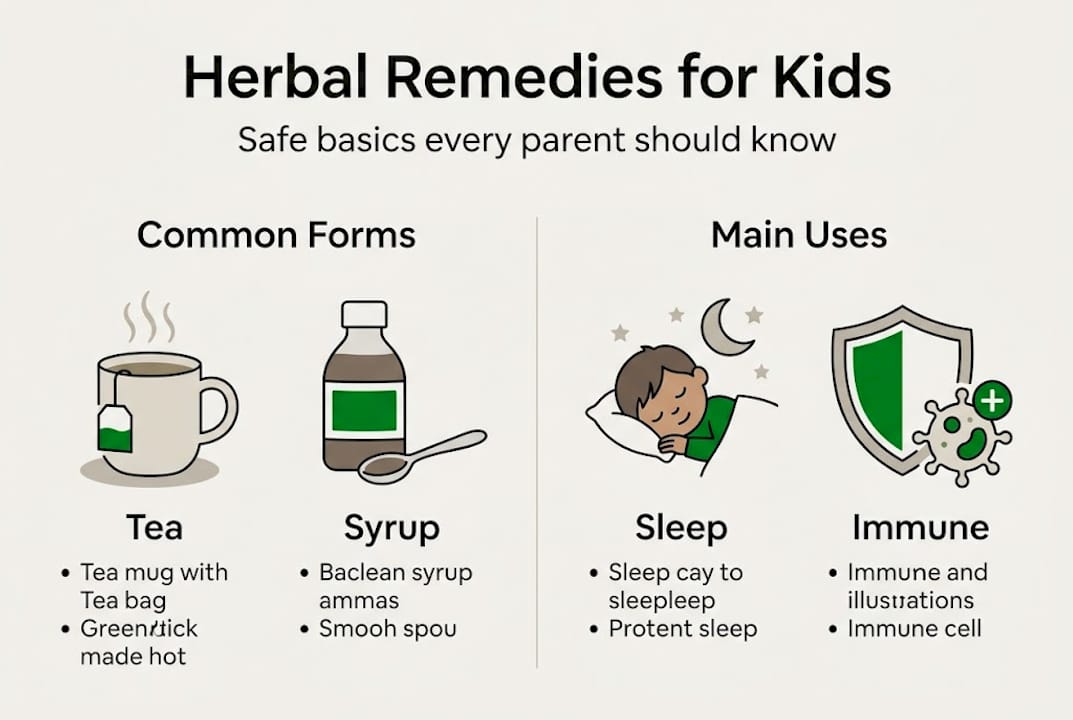
These products are more popular than many parents realize. 5% of US children used natural products in 2012, and that number has likely grown since then. Parents often turn to herbal options because they trust the word "natural," want to avoid pharmaceutical side effects, or feel conventional medicine doesn't have good answers for mild, recurring issues like colds or trouble sleeping.
Here's the biggest misconception worth addressing right away: natural does not automatically mean safe. Herbs are biologically active. They can interact with medications, cause allergic reactions, and affect developing bodies differently than adult bodies. Another common myth is that if something is herbal, it must work. Effectiveness varies widely depending on the herb, the condition, and the quality of the product.
Herbal supplements also differ from conventional drugs in one critical way: regulation. Drugs must prove safety and efficacy before reaching shelves. Herbal supplements do not. This makes product selection and professional guidance especially important when you're considering herbal remedies for families.
Common herbal remedies used for children
| Remedy | Common use | Form |
|---|---|---|
| Chamomile | Sleep, digestion | Tea, drops |
| Echinacea | Immune support | Syrup, drops |
| Lemon balm | Anxiety, sleep | Tea, tincture |
| Pelargonium sidoides | Respiratory infections | Drops, syrup |
| Probiotics | Gut health, infection duration | Powder, capsule |
Building a foundation of herbal wellness for parents starts with understanding these basics before reaching for any product. Exploring family immunity strategies alongside herbal options gives you a fuller picture of what supports your child's health naturally.
Preparing to use herbal remedies safely
Once you know what herbal remedies are, the next step is learning how to evaluate safety and suitability for your child.
Before giving any herbal product to your child, a conversation with their pediatrician or a qualified naturopathic doctor is non-negotiable. Herbal supplements for children are not regulated like drugs, and label contents may not match what's actually inside the product. That's a serious concern when you're dosing a 30-pound child.
Here are the key safety checks to run through before starting any herbal remedy:
- Age appropriateness: Many herbs are not tested or approved for infants or toddlers under age 2.
- Allergy history: Plants belong to families. A child allergic to ragweed may react to chamomile or echinacea.
- Current medications: Some herbs interact with common medications, including antibiotics and antihistamines.
- Medical history: Children with liver conditions, kidney issues, or immune disorders face higher risks.
- Product quality: Look for third-party certifications like USP, NSF, or ConsumerLab on the label.
Certain groups should avoid herbal supplements entirely unless under direct medical supervision: infants, immunocompromised children, kids with known plant allergies, and children with chronic GI conditions.
Always read the full product label. If it doesn't list age guidance, dosing instructions, or a third-party certification seal, put it back on the shelf.
Following herbal best practices and reviewing herbal nutrition safety resources can help you make smarter choices. For a broader view of child wellness, the ear health checklist for kids is a useful reminder that natural health covers more than just supplements.
Pro Tip: Start with the lowest suggested dose and wait at least three to five days before increasing. Watch for any changes in digestion, skin, energy, or behavior. Early reactions are much easier to manage when you're going slowly.
Choosing evidence-based remedies for common kid concerns
Now, let's look at which herbal remedies have actual research backing for the most common childhood issues.
Not all herbs are created equal when it comes to kids. Some have solid clinical data. Others are popular but under-studied for pediatric use. Here's a clear breakdown of the best-studied options:
- Pelargonium sidoides (EPs 7630): This South African herb has strong support for respiratory infections. Pelargonium reduces severity and duration of respiratory infections in children and is well tolerated. It's one of the most researched herbal options for kids with colds and bronchitis.
- Probiotics: Probiotics may shorten infection duration in children, particularly for respiratory and GI infections. They're generally considered safe and are widely available in child-friendly forms.
- Lemon balm: Used for mild anxiety and sleep difficulties. A review of 29 trials supports the use of lemon balm, lavender, and valerian for anxiety and sleep under supervision.
- Lavender: Topical and aromatherapy use for calming and sleep support has a reasonable evidence base for older children.
- Valerian: Sometimes used for sleep issues in older children, though evidence is less consistent than lemon balm.
A meta-analysis of 66 RCTs covering 7,176 children found herbal medicine improved effective rates for the common cold with a favorable safety profile compared to conventional medicine. That's meaningful data.
Comparison of top herbal options for kids
| Herb | Best for | Evidence strength | Safe age range |
|---|---|---|---|
| Pelargonium sidoides | Respiratory infections | Strong | 1 year and up |
| Probiotics | Gut health, infections | Moderate to strong | All ages |
| Lemon balm | Anxiety, sleep | Moderate | 3 years and up |
| Lavender | Calming, sleep | Moderate | 2 years and up |
| Valerian | Sleep | Limited | 6 years and up |
What to avoid: ginseng, garlic supplements in high doses, and herbs with no pediatric research at all. Reviewing herbal ingredients and evidence and starting with a beginner herbal remedy guide will help you navigate the options. For respiratory concerns specifically, understanding strep throat care for kids helps clarify when herbal support is appropriate versus when antibiotics are necessary.
Pro Tip: For mild issues like occasional restlessness or a light sniffle, a gentle tea is often the safest and most appropriate starting point before reaching for a concentrated tincture or capsule.
How to give herbal remedies: Dosing, forms, and age guidance
Once you've picked the right remedy, it's crucial to use the safest methods and monitor your child closely during introduction.
The form of an herbal remedy matters as much as the herb itself. Here's a step-by-step approach for introducing herbal remedies to children:
- Assess your child's needs and health status. Confirm with a provider that an herbal option is appropriate for your child's age, weight, and current health.
- Choose the right form. Weak teas work well for toddlers and school-age kids. Syrups are easier for younger children. Drops and tinctures offer precise dosing but often contain alcohol, so look for glycerin-based versions for kids.
- Start with the lowest dose. Use weak dilutions for teas and start at the lowest suggested dose. Never use adult dosing for children.
- Observe for three to five days. Watch for skin changes, GI upset, mood shifts, or changes in sleep. Keep a simple log.
- Adjust or stop as needed. If you see any reaction, stop the remedy and contact your provider. If it's going well, you can continue at the established dose.
Age matters enormously here. Children under 6 months should not receive any herbal products. Children under 2 years require extra caution. For children aged 2 to 6, only the gentlest, best-studied options should be considered, and always in consultation with a provider.
For anxiety and sleep support, lemon balm, lavender, and valerian have the most pediatric research behind them across 29 trials. This makes them a reasonable starting point for parents exploring gentle support for older children.
The herbal nutrition guide at Finer Holistics provides additional context on safe ingredient choices for families.
Pro Tip: Choose products with clear labeling that includes the herb's Latin name, the plant part used (root, leaf, flower), the dose per serving, and a third-party testing seal. Vague labels are a red flag.
Troubleshooting problems and knowing when to stop
Proper use is only half the equation. You also need to know how to spot problems and act quickly if things don't go as planned.
Even well-researched herbal remedies can cause reactions in individual children. Knowing the warning signs helps you respond fast.
Stop the remedy immediately if you notice:
- Skin rash, hives, or swelling
- Digestive upset: vomiting, diarrhea, or stomach cramps
- Unusual fatigue or drowsiness
- Behavioral changes: increased irritability, hyperactivity, or mood shifts
- Breathing changes or wheezing
Mild GI upset that resolves quickly may not require a provider call, but any skin reaction, breathing change, or symptom that persists beyond 24 hours warrants a call to your pediatrician. Severe reactions like throat swelling or difficulty breathing are emergencies. Call 911.
Some children are at higher risk for adverse reactions. Infants and immunocompromised children face greater risks due to liver and kidney immaturity and reduced ability to process plant compounds. Children with GI disorders or known plant allergies also fall into this higher-risk category.
The most common mistake parents make is assuming that because a product is sold for children, it has been tested and approved for children. That is not how supplement regulation works in the US.
Other frequent mistakes include following adult dosing instructions, mixing multiple herbal products at once, and stopping conventional treatments in favor of herbal options without provider guidance. Review the herbal supplement checklist to make sure you're covering all your bases before and during use.
A realistic perspective on herbal remedies for kids
Having covered the step-by-step process, here's a frank take on what works, what's overrated, and how to build a responsible approach.
After years of working with plant-based remedies, one thing stands out clearly: the parents who get the best results are not the ones who find the perfect herb. They're the ones who build a thoughtful, supervised approach and keep their expectations grounded.
"Natural" is not a synonym for "better" or "safer." Some of the most toxic substances on earth are completely natural. The value of herbal remedies lies in their gentle, supportive role, not in replacing medical care. They work best as part of a broader wellness strategy, not as a first-line treatment for serious illness.
Most parents who struggle with herbal remedies for their kids have one thing in common: they relied on online forums instead of qualified practitioners. The information online ranges from excellent to genuinely dangerous, and it's nearly impossible to tell the difference without a solid knowledge base.
The honest truth is that herbal remedies can offer real, gentle support for everyday childhood concerns when chosen carefully and used under guidance. But the safest path always runs through honest, ongoing dialogue with a trusted provider. Explore herbal wellness for parents to keep building your knowledge base.
Get expert guidance and high-quality remedies
If you want support on your herbal wellness journey, here are trustworthy resources to guide and supply you.
At Finer Holistics, we believe that plant-based wellness should be accessible, safe, and grounded in real knowledge. Every product we offer is handcrafted with carefully selected ingredients and designed to support the body's natural ability to maintain health and balance.

Whether you're exploring herbal detox remedies for the whole family or looking into women's wellness herbs for yourself, our collections are built with quality and transparency in mind. We also provide ongoing education through our wellness blog so you can make informed decisions for your family every step of the way. Your child's wellness deserves both the wisdom of plants and the guidance of trusted practitioners.
Frequently asked questions
Which herbal remedies are safest for young children?
Mild teas like chamomile or lemon balm and Pelargonium sidoides for respiratory infections have supportive research, but always consult a pediatrician before starting any herbal remedy for a young child.
Are herbal remedies regulated for kids?
In the US, herbal supplements are not regulated like medicines, which means quality, safety, and label accuracy can vary widely between brands and products.
When should I avoid giving herbal supplements to my child?
Avoid herbal products in infants, immunocompromised or allergy-prone children, or those with chronic health conditions unless a qualified provider is directly supervising their use.
What should I do if my child reacts badly to an herbal remedy?
Stop the product immediately and contact your child's healthcare provider if you notice side effects like a rash, breathing changes, or severe fatigue. For serious symptoms, seek emergency care right away.